Sunday, 3 March 2013

My first five years; 1973-78.

Before I begin this series of posts, I have to acknowledge that it was inspired by Melissa at Talk About York (formerly Home office Mum), who has been summing up each decade of her life as she turns 40 in a series of incredibly well-written posts. As I am also nearing this landmark, I started to think what a great idea this was. I'm not only doing it for myself, but for my children - who really knows about their parents' lives after all, unless said parent is a celebrity and writes an autobiography? And, to be honest, I'm also doing it to remind myself of who I am, at a challenging period in my life where I sometimes lose sight of the person I have been for the past 40 years.

I did face a few challenges. I started writing this and realised no way was I going to fit everything I want to say into five posts. So I'm splitting it into eight posts, each covering around five years. If that is simply too much to wade through, look away now. Another challenge is lack of any photos - all our family albums are currently sitting in my sister's garage, and my own non-digital photos are in a cottage in Berkshire. And so I've had to rely on the internet to find relevant pictures for this post. But - it's amazing what you can do with Google these days. Finally, there's the fact that my mother died in 1998, and is not around to fill in some of the detail. (Dad, if you are reading, perhaps you can correct me on any point).

So: the first five years.

I was born in Harold Wood Hospital, Essex; within the London borough of Havering, so I suppose I can legitimately call myself both a Londoner and an Essex Girl. My mother was a teacher in a primary school nearby, my father worked in banking in the City. Around the time of my birth, they moved to Hutton, near Brentwood, buying a Victorian house.

 I found this image on Google Streeview! It looks very different from how it did in the 70s.


My mother, who had a passionate dislike of modern houses, always said that our house had "character". And she was right. At the back of the house was a conservatory, with a magnificent grape vine growing from its ceiling. These grapes hung down in succulent bunches in summer, attracting many wasps. I believe my parents tried to make wine from them, but never succeeded.

Our garden was large and wide, with a shady area down the end that I used to find vaguely exciting, large blue hydrangea bushes (to this day, I love blue hydrangeas) and a silver birch that was planted to commemorate my birth. And there was an outside loo in a brick outbuilding, which always had spiders in it.

What else do I remember? The hallway was painted deep purple, and when my baby sister was born, her nursery was painted deep orange. Years later, I would live in a house with a purple dining room and (pale) orange nursery - painted by us. There's a starting point for a Dulux ad (can I copyright it, please?).

But one day, everything changed. Here's a vivid memory; one day, in 1976, my father threw me up in the air in bed, and said: "We're going to Hong Kong today!"

I remember nothing about the aeroplane journey (which took around 22 hours in those days. Presumably it was hellish for my parents, with a six week old newborn and me, aged three). I often wonder what was it like for my mother, arriving in a far-off country with two small children in the days before the internet and emails.

My mother in the 1970s, walking on The Peak

Obviously as a child, I was unaware of any of this upheaval. I remember only little vignettes; visits to the beach with with buckets and spades, and an elaborate routine of cleaning the sand from our feet before returning to the house, involving buckets of water carried by my mother. Shopping in Central, and visits to the narrow "lanes" which sold tiny children's shoes and huge rolls of material for making clothes. Visits to Stanley market, with its mangy dogs and rattan baskets of rotting vegetables and stalls selling piles and piles of denim jeans.

I caught whooping cough, which seemed to me to last for ages, and perhaps it did. Every day I would ask my mother "Am I better now?" and she would say "Nearly." They must have been worried about my weight, because I remember always having to be weighed on the bathroom scales. 

At some point I started preschool, at the house of a New Zealand woman called Mrs Pryor.  It seems amazing now that she actually ran a preschool in her own ground floor apartment, but it seemed to work well. We played outside in a large communal garden, and ate Ritz crackers at breaktime. Mrs Pryor had an adopted Korean daughter called Sonya, who was my friend, and this seemed very intriguing. At this point I am sure my mother was talking about the idea of adopting a Vietnamese refugee baby. (She couldn't have any more children, having suffered from pre-eclampsia during my sister's birth). It didn't happen. I wonder what life would have been like had she done so?

Google Streetview strikes again; this is the road where my preschool was.

And finally, when I was five years old, I started "big school", at Glenealy Junior School in Hornsey Road. The next five years are naturally much clearer in my memory, and were to be some of the happiest of my life.




Tuesday, 26 February 2013

American healthcare; a new perspective.

 Unfortunately, none of the doctors I've come across so far look like McDreamy...


I've always been rather rude about healthcare in the US compared to the UK. In general I tend to sing the NHS's praises, and I approve of free-at-the-point-delivery healthcare in principle, whereas an insurance-based system is unfair, too open to random money-spending (and charging by insurance companies) and in the end, no better than what we have at home.

And I still hold by most of that. I hate that one's decision whether or not to visit a healthcare provider is always clouded by "how much will the co-pay be?". That some medications are not covered by your insurance. That if people lose their job, they lose their insurance. Or it changes, and they have to change all their healthcare providers. It's definitely unfair, it's confusing and I think most British people would be shocked by it. One of the best things Obama has done is to try to reform healthcare in the US. (Not that he's really succeeded - the Republicans are making sure of that.)

I tend to laugh when Americans knock "socialized medicine", because they seem to have this great fear of the unknown, when their own system is far from perfect. For example; in the US, you are often kept waiting for routine appointments, and there is no apology given. Medical receptionists are notoriously grouchy and unhelpful here. Emergency room visits are all very similar to what would happen at home. (Note: it is nothing like Gray's Anatomy, ER or House.)

Having said all that; my recent healthcare experiences have taught me that there are some advantages to being in America. You can, for example, go and see a specialist with literally a few days' notice. You don't have to be referred by a GP (GPs/primary care practitioners here being a bit different from what they are home, and generally, not that helpful). You simply ring up - yourself - and get an appointment, often that same week. If you are anxious to get on with things, that is definitely helpful.

Yesterday I spent the morning at our local hospital (for which The Doctor works) having a series of investigations. I have to say, it was extremely efficient - hardly any waiting around, everything happened like clockwork, the staff were kind and courteous, the environment was squeaky-clean and pleasant. From my experience of similar appointments within the NHS at London teaching hospitals (which were only ever pregnancy related, I must say), this was a definite improvement. By the way, I don't blame individual doctors or nurses in any way; the NHS is simply run off its feet half the time. In some ways, it's a miracle that anything happens at all.

But that is private healthcare. Would my Hispanic cleaning lady get the same treatment at the local public hospital, using Medicaid? I doubt it somehow.

Still, if there is nothing else good about my ongoing horrible situation, at least I am finally able to compare the two systems from an informed point of view. And no, I haven't found Dr. House yet.


Friday, 22 February 2013

Empathy. Or, no more Mrs. Nice gal.

I talked a little bit about empathy in my last post, and I've been thinking about it as a concept. (Incidentially, does anyone remember history GCSE, where you had to write essays that showed "empathy" with someone's situation? For example, I remember writing a long sob story about an Irish family emigrating to America during the potato famine. There was also the person in our class who started an essay about a WWI soldier with the words "Wrote another poem today".  Our teacher used this as an example of how not to do an empathy essay.)

Someone said to me that this whole experience I've been going through might make me a more empathetic person in the long run. And they could be right. But, at the moment, I feel like it's making me seriously less empathetic - at least, with some people.

For instance, when someone tells me they feel utterly shit with a cold, or that they had a bad night's sleep, I mutter sympathetically, but my inner devil is muttering: "So? What do they know about feeling utterly shit? One bad night's sleep? Pah! Try a whole six weeks."

When, as happened today, several friends cancel playdates I'd arranged for the boys, because they are feeling a bit under the weather or simply "have too much going on", my blood boils. For God's sake, I think. Today I feel like I can hardly stand up, but am still planning to take my kids to piano and swimming and was quite willing to meet up with people for pizza in order to entertain my chidren. Because, when every day is a crappy day, you simply have to carry on with life as best you can.

I do remember feeling a little the same when my mother died. When something that traumatic happens, one of your reactions is to feel a little bit less sympathetic to people's every day woes. So, for a period, I turned from a mild-mannered editor at work into someone whose patience wore very thin when I felt my underlings weren't trying their hardest. Somehow, something hardens inside you when these things happen. But then again, I probably became a better editor as a result.

I know it is all relative. Everyone's situations could be worse. There are plenty of people in the world far worse off than me, and then there are people who have a cold and wish they felt better. I have friends who are going through great trials (sick children, marriage breakups) and I would not even presume to know how bad they are feeling.

But, perhaps this post may explain why it may be no more Mrs. Nice Gal for the moment. Hopefully temporarily. Readers will have to be patient and forgive the odd rant.


Wednesday, 20 February 2013

Some stuff I've learned in the past few months.

1. Your health is the most important thing you have. Never take it for granted.

2. When illness strikes (and I am talking about for more than a couple of weeks) you really know who your friends are. And your family.

3. Appreciate every minute you get to spend with your children - even the shouty, grumpy ones. You never know what is around the corner. It could be you, it could be them. Life, health and happiness are not assured. Hug your children and tell them you love them every single day.

4. Even if you eat the healthiest diet, do lots of exercise and go for regular de-stressing activities like massage, it won't stop something from happening to you out of the blue. Go figure.

5. Making a superhuman effort to get on with things is actually better than "resting". Resting gives you too much time to think.

6. The problem with 5) is that everyone, including your initially concerned friends, will assume you feel better because you are not moaning on about your problems any more,

7. This only leads to more feelings of isolation.

8. Doctors are not God. Even the one you are married to. They cannot fix everything with a pill. The drugs don't always work, and sometimes cause more problems.

9. Even the strongest marriage can be put under strain by chronic ill health. It is impossible for one partner to really understand what the other is going through (especially when you don't have a diagnosis). And there is pressure on both of you.

10. It is irritating when everyone tells you that you are brave and "I don't know how you manage". The fact is, you have to. You just have to deal with it.

11. Everyone knows a new chiropractor, physiotherapist, acupuncturist, dietician or some other guru whom you absolutely HAVE to see. You know they are trying to be helpful, but at a certain point you just don't need any more suggestions Also, some people will almost act offended if you don't try their person - as if you aren't helping yourself. This makes you feel guilty.

12. Empathy is what you need most. Not sympathy as such, but empathy. Like when your neighbour comes up and tells you she has been going through terrible insomnia due to toothache, and now she understands how much you must be going through after four months of this. You appreciate those moments.


Monday, 18 February 2013

Living with uncertainty

I haven't blogged about my health issues recently because (I always thought), I'm not that type of blogger. I'm not into oversharing, or looking for sympathy, or boring everyone rigid with complaints about my health. I'm not even the sort of person who moans on Facebook every time she has a cold, for goodness' sake.

But someone suggested it might be cathartic to do so, and so I'm going to try.

The fact is that I feel very ill. I've gone from being a completely healthy and happy person last summer to feeling as if I'm about 80, and completely miserable with it.

What started as knee pain, and was then (mis?)diagnosed as sciatica, has turned into severe leg pain and all sorts of other unusual symptoms happening to my body. Not surprisingly, I got very depressed and anxious about it, and that didn't help, as I then had a bout of severe insomnia. I'm now taking sleeping pills, which have eventually worked. The other thing I was prescribed was depression medication. This not only didn't work, but caused all sorts of really distressing side effects; shaking hands, muscle twitches, almost a zombie-like state of mind where I didn't really care about anything but still felt miserable. So, I decided to come off them - slowly, as advised. But the withdrawal symptoms have been horrible; burning, tingling feelings in my hands and feet, feelings of numbness, muscles contracting horribly in every part of my body, dry mouth that means you can't enjoy food or drink as much as usual, cloudy vision that means I find it hard to read or actually do my job. 

And now I'm starting to wonder if they really are withdrawal symptoms, or whether it's all part of some underlying condition. I've had blood tests, which were all negative, although I've just been back for more. I've been seen by a neurologist, an orthopaedist, a psychologist and next it's a rheumatologist. I've had three MRIs and am going for another two next week. I spend my life in doctor's waiting rooms, or doing physical therapy, which so far hasn't produced any results. I've tried all sorts of alternative approaches: acupuncture, yoga, chiropractor. All of them just seem to result in more pain. Mentally, I've tried to cheer myself up; with doing stuff with the boys, going out more with my husband, seeing more of friends - all nice things, but again don't help with the physical pain and feeling like crap. I can't do any of the nice outdoorsy things I used to do - running, skiing, hiking. Just doing the dishes and laundry is painful.

What I actually would like at this point in time is a diagnosis. It may not be nice, but at least then I could start dealing with it. I hate the uncertainty, the not knowing how long this will last, the constant sense of horror at what's happening to my life.

What I would like is Dr House to come along, put all my symptoms on a whiteboard, and work it out. (I wouldn't mind if he looked like Hugh Laurie either). What I don't need is another doctor to say: "But the tests are all negative, what are you worried about?" Because at this point, that doesn't help.

And most of all, I want this person back. 


Monday, 11 February 2013

A winter storm


We've had our fair share of storms on Long Island this past 18 months.

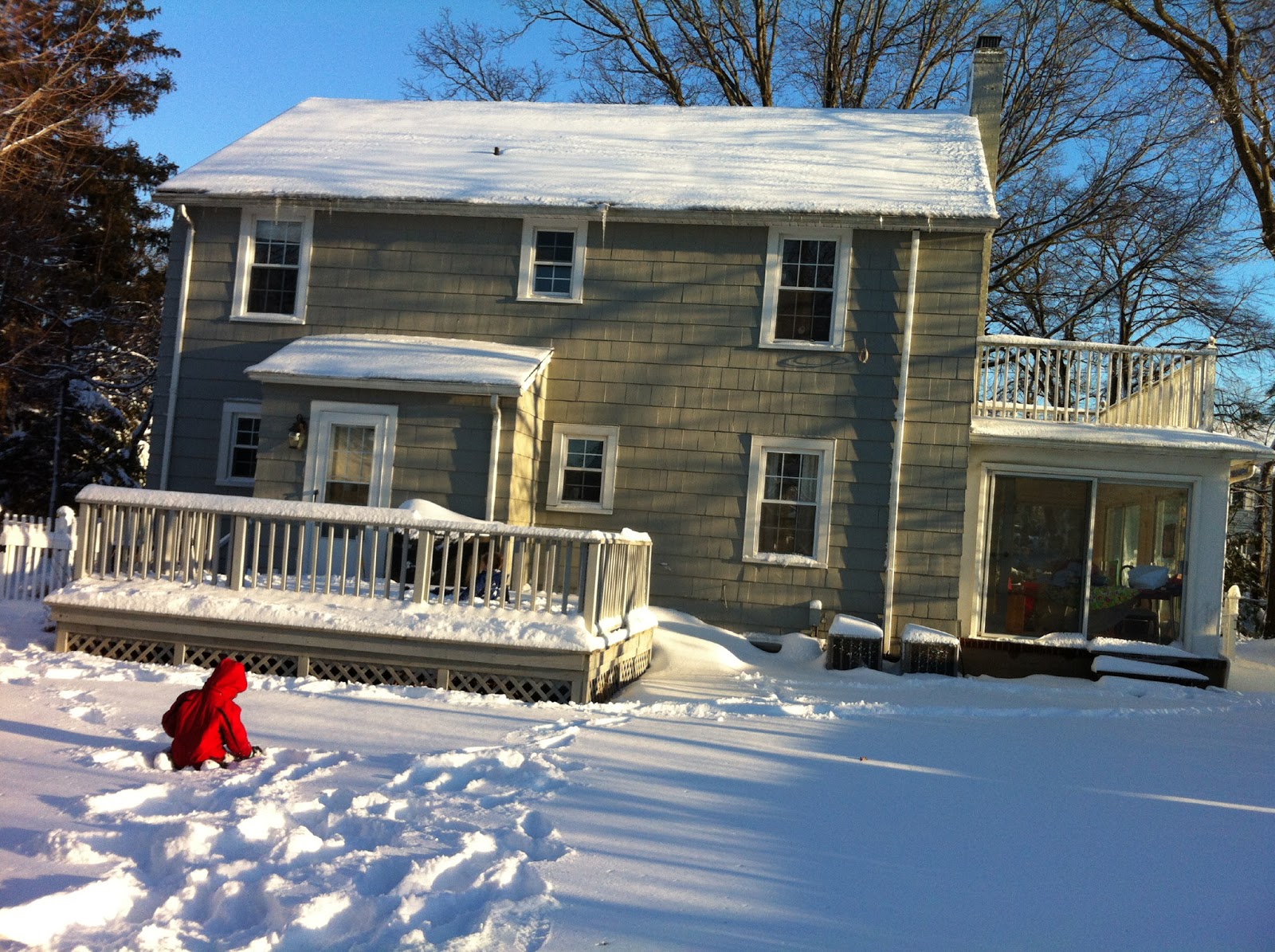
So it was lucky, this time, with Winter Storm Nemo, that we caught a break. Although there was extremely heavy snow on Friday on eastern Long Island (many people were stranded in their cars overnight on the Long Island Expressway), it didn't hit our town too hard. We had about a foot of snow, but we've had more before. This time, it was just pretty.

The boys built a snowman and had snowball fights, while I went around photographing the house in the snow (it's the first time we've had a major snowfall in the new house).

Having stocked up on food the day before, (anticipating power outages and the like) on Saturday, we didn't have to go anywhere, but snuggled together in the fading afternoon and watched an old James Bond film (The jury is out on whether the boys really like Bond films, but we rather enjoyed the cheesiness of You Only Live Twice.)

The next day was beautifully sunny and crisp. We took the boys sledding, which they loved; however, after about 20 minutes the police came and told everyone to clear out of the golf course (where the best sledding hills are). We thought they were being killjoys at first, until someone said they'd heard an ambulance. Today, we heard that an eight year old girl had been seriously injured, hitting a tree in a sled. While the boys did wear helmets yesterday, it did make me realise (if I didn't know it already) that sledding is a pretty dangerous activity. So, take care in the snow, fellow parents - I know you're expecting some in the UK. 

Today, it's all melting away to grey slush. But I'm glad we got to see one more heavy snowfall on Long Island, even if it's our last. 

Monday, 4 February 2013

Short musings on the Super Bowl.

Does wanting to watch Downton Abbey on PBS rather than the Super Bowl on CBS mean that I am mentally adjusting to our return to England?

I don't think so. I seem to recall it was the same last year. I mean, I just cannot understand American Football. Ten seconds of play, some rather violent shoving, then it's on to the next 'timeout' or ad break. No wonder plenty of people watch it purely for the ads.

Although it did seem appropriate that this year's big game featured a "power outage". That seems to be such a feature of American life now that it seemed almost symbolic. That you can go from the multi-million dollar pyrotechnics of Beyonce's performance to a massive blackout in a few minutes just seems to sum up the extremes of life in the USA. Not to mention that player dropping the "F-bomb" live on camera at the end of the game, in conjunction with the word "awesome".

Anyway. Give me Maggie Smith over huge men in tight trousers, ads for Bud Light and pompom girls any day. Maybe I really have been here too long.